Most hiring guides on Serbia are thin agency pages that recycle the same three talking points. "Growing IT sector." "European culture." "Competitive rates." Then they slap an EOR affiliate link at the bottom and call it a day.
This is the actual guide. The one I wish existed when I started looking at Serbia as a hiring market. I'll cover real salary numbers, the legal structure you need to understand, the time zone math that matters, and where Serbia genuinely stands compared to Poland, Ukraine, and Romania. No fluff. Just what you need to make a decision.
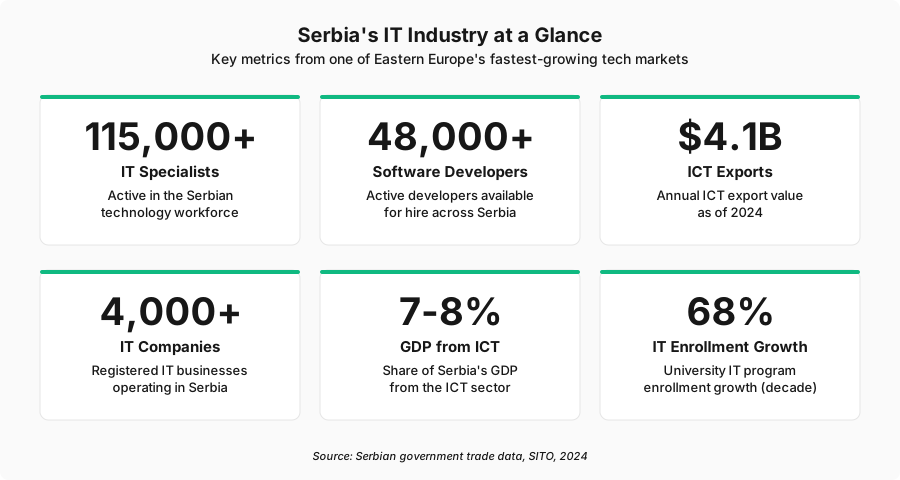
Let me start with the number that caught my attention first. Serbia's ICT sector hit $4.1 billion in exports in 2024, representing roughly 7-8% of the country's GDP (Serbian Chamber of Commerce). For a country of 6.6 million people, that's a staggering concentration of tech talent relative to population size.
Why Serbia keeps showing up on hiring shortlists
The Serbian IT story isn't new, but it's accelerating faster than most people realize.
There are over 115,000 IT specialists working in Serbia today, with roughly 48,000 of those being active software developers (IT Serbia Initiative, SITO). The number of IT companies has crossed 4,000. University enrollment in IT programs has grown 68% over the past decade (Serbian Ministry of Education). That pipeline matters because it means the talent pool isn't static. It's compounding.
The big names figured this out years ago. Microsoft has had a development center in Belgrade since 2005. It's one of their largest R&D operations in Europe. Ubisoft built a studio there. NCR runs significant operations. Epic Games set up shop. These aren't satellite offices doing support work. They're doing core product development.
The Nordeus story is the one I keep coming back to. A Belgrade-based game studio, founded by three Serbian developers, built Top Eleven into the most popular mobile sports management game in the world. Take-Two Interactive acquired them for $378 million in 2021 (Take-Two Interactive). That acquisition proved something important. Serbian developers aren't just writing code for foreign companies. They're building products that compete at the highest level globally.
The government has leaned into this too. Serbia offers a tax incentive for IT companies where qualified tech workers can receive a 70% reduction on income tax and social contributions. That's aggressive, and it's pulled in a lot of international investment. The startup ecosystem in Belgrade is the strongest in the Western Balkans, with Serbia ranking first in the region on the Global Innovation Index (WIPO, 2024).
Where the developers actually are
Serbia isn't like some countries where all the talent clusters in one city. There are three real hubs, each with a different character.
Belgrade is the biggest by a wide margin. The capital has the largest concentration of IT companies, the most mature startup ecosystem, and the broadest mix of enterprise and product work. The University of Belgrade's Faculty of Mathematics is one of the top computer science programs in Southeastern Europe. Most international companies set up here first. Salaries are highest here too, which I'll get into below.
Novi Sad is the one that surprises people. Serbia's second city has been quietly building an IT scene that rivals Belgrade in quality if not in size. The University of Novi Sad has an excellent Faculty of Technical Sciences, and the city hosts EXIT Festival every summer which has turned it into a magnet for younger tech workers who want a lower cost of living than Belgrade. Several major companies have offices here. The talent quality is equivalent to Belgrade with salaries running 10-15% lower.
Nis is the emerging third hub. Located in southeastern Serbia, it has a strong technical university and significantly lower costs than either Belgrade or Novi Sad. If you're building a team and cost optimization matters, Nis is worth a serious look. The trade-off is a smaller talent pool, so scaling beyond 10-15 developers gets harder.
There's also a growing distributed workforce across smaller cities. Serbia's internet infrastructure has improved dramatically. Belgrade averages 85 Mbps download speeds, and even secondary cities are well above what you need for remote work (Speedtest Global Index).
What you'll actually pay
Two salary realities exist in Serbia, just like every other emerging tech market. What local companies pay in Serbian dinars, and what international companies pay for remote talent. These are different numbers and you need to understand both.
For remote developers hired by US or Western European companies:
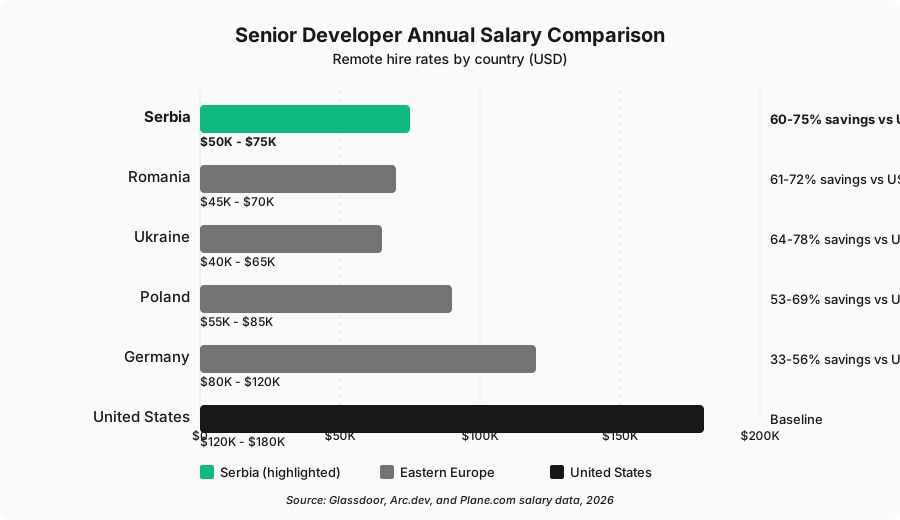
Junior (0-2 years): $20,000 to $30,000 per year.
Mid-level (3-5 years): $35,000 to $50,000 per year.
Senior (5+ years): $50,000 to $75,000 per year.
Lead/architect level: $70,000 to $90,000 per year.
(Sources: Arc.dev, Talent.com Serbia, Glassdoor Serbia, Alcor)
Hourly contractor rates for Serbian developers typically run $25 to $49 per hour depending on experience and specialization (Upwork, Toptal market data). DevOps and cloud architects command the top end. Frontend React developers sit in the middle. QA and junior roles are at the lower end.
Now let's talk total employer cost because this is where people get confused. If you're hiring through an EOR or setting up an entity, you're not just paying salary. Serbia has a flat 10% personal income tax. Employer social contributions add approximately 15.15% on top of gross salary, broken down as pension insurance (10%) and health insurance (5.15%) (Serbian Tax Administration). Unemployment insurance (0.75%) is paid by the employee, not the employer. That's actually quite low compared to most of Europe. Germany loads 20%+ on the employer side. France is even higher.
Here's the comparison that matters:
Versus the US, you're looking at 60-75% total cost savings when you factor in salary difference plus the dramatically lower benefits burden. A senior US developer costs $150,000-$200,000 fully loaded. A senior Serbian developer costs $57,000-$86,000 fully loaded.
Versus Western Europe (UK, Germany, Netherlands), savings run 40-65% depending on the specific market and role.
Versus Poland, Serbia is 10-20% cheaper for equivalent experience levels. This gap has been narrowing as Poland's salaries have risen significantly since EU accession, but it's still real.
Versus Romania, costs are roughly comparable. Serbia edges slightly cheaper in some specializations.
A Serbian developer earning $50,000 per year is living very well by local standards. The average net salary in Serbia is around €860 per month (Statistical Office of the Republic of Serbia, 2024). Someone earning $4,000+ per month is in the top income bracket. A nice apartment in central Belgrade runs €500-800 per month. In Novi Sad, it's €350-600. This is why the arrangement works for both sides.
Tech stack strengths
Serbia's developer ecosystem has specific strengths that trace back to how the IT industry developed there. Understanding these helps you hire smarter.
Java and .NET/C# are the dominant enterprise stacks. This comes from the heavy influence of Microsoft (development center since 2005) and the enterprise outsourcing industry that grew through the 2010s. If you need backend Java developers or .NET engineers, Serbia is one of the strongest markets in Eastern Europe. The depth here is genuinely impressive.
JavaScript ecosystem is strong and growing. React and Angular are the most common frontend frameworks. Node.js adoption on the backend has grown significantly. Full-stack JavaScript developers are abundant, especially in the mid-level range.
Python has gained ground rapidly, driven by data engineering, automation, and the growing AI/ML specialization. You'll find solid Python developers but the pool is smaller than Java or JavaScript.
Cloud and DevOps is where Serbia has an interesting edge. Because of Microsoft's major presence, Azure expertise runs deep. You'll find more Azure-certified engineers per capita in Serbia than in most European markets. AWS and GCP skills exist too, but if your stack is Azure-heavy, Serbia should be near the top of your list.
AI and machine learning is the newest growth area. The University of Belgrade and University of Novi Sad both have active AI research programs. Several Serbian startups are building AI products. The talent here is still relatively junior compared to the US or UK, but it's growing fast and it's priced attractively.
The honest gap: if you need highly specialized roles like Rust systems programming, blockchain/Solidity, or niche DevOps tools, the pool thins out quickly. Serbia's strength is in the mainstream enterprise and web development stacks.
The time zone reality
Let me be honest about this because time zones can make or break a remote hiring decision.
Serbia operates on Central European Time (CET, UTC+1) in winter and Central European Summer Time (CEST, UTC+2) from late March to late October.
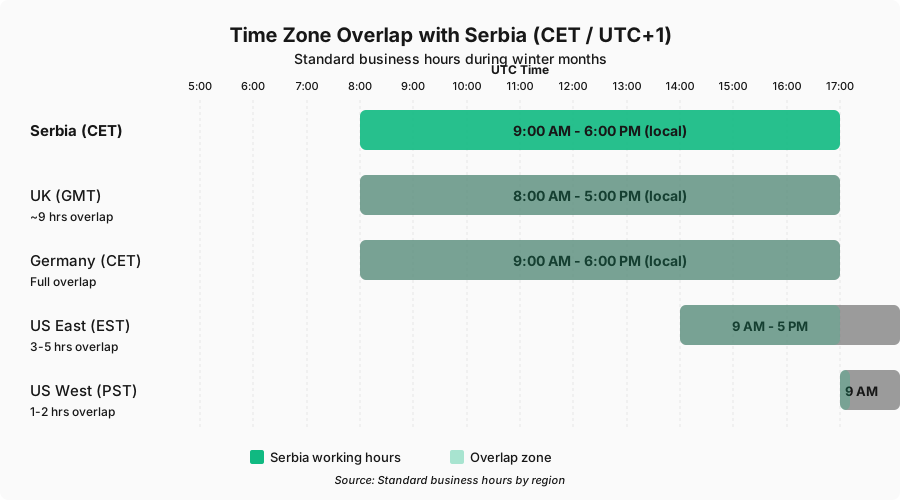
For UK and Western European teams, this is close to perfect. Serbia is one hour ahead of London and on the same time as Paris, Berlin, and Amsterdam. Full-day overlap. No compromises needed. This is one of the biggest reasons European companies love hiring in Serbia.
For US East Coast teams, you get 3-5 hours of direct overlap depending on the season. When it's 9am in New York, it's 3pm in Belgrade. A Serbian developer's workday from 9am to 6pm Belgrade time gives you overlap from roughly 9am to 12pm Eastern. That's enough for a morning standup, a planning session, and real-time collaboration on blockers. The afternoon on the US side is async. This works fine for most teams if you build your processes around it. But I won't pretend it's the same as nearshore.
For US West Coast teams, the math gets rough. You're looking at maybe 1-2 hours of overlap, and that's if your Serbian developer stays late. Realistically, this is an async relationship. It can work extremely well with the right tooling and communication norms. Yander was built specifically for managing teams across time zones like this, with async handoffs and visibility into work progress without requiring everyone to be online simultaneously. But if you're a West Coast company that relies on synchronous pair programming or live whiteboarding sessions, Serbia is not your market. Look at hiring in Colombia or Mexico instead.
The one upside of the time zone gap with the US: your Serbian team can work a full day before your US team even wakes up. I've seen companies use this to their advantage. Bugs filed at end of US business day are fixed by morning. Sprint tasks move forward overnight. It creates a follow-the-sun dynamic that actually increases throughput if you set it up intentionally.
How to actually hire (legal and logistics)
Three paths. Each with different trade-offs.
Path 1: Direct contractor relationship. The fastest way to start. No entity needed. The developer invoices you, you pay them. But Serbia introduced new rules in 2023 that you need to know about. The "130-day rule" means a contractor who works more than 130 days in any 12-month period for one client can be reclassified as an employee. There's also an exclusivity test. If more than 70% of a contractor's income comes from a single client, that triggers scrutiny. And if you're setting their schedule and telling them exactly how to do the work (as opposed to defining outcomes), that's another red flag. Misclassification penalties include back payment of all social contributions and taxes, plus fines. Take this seriously.
Path 2: Employer of Record (EOR). This is what most companies use to hire full-time in Serbia without setting up a local entity. Companies like Deel, Remote.com, Oyster, or Papaya Global act as the legal employer. You manage the work, they handle payroll, tax withholding, social contributions, and compliance. Setup takes 1-2 weeks. Monthly cost runs $300-$700 per employee on top of salary. The EOR handles the 10% income tax withholding, the 15.15% employer social contributions, and mandatory benefits like 20 working days of annual leave, sick pay, and maternity/paternity leave. Clean. Compliant. The trade-off is cost and the fact that the employment contract is between the worker and the EOR, not you.
Path 3: Own entity. Register a d.o.o. (društvo sa ograničenom odgovornošću), which is Serbia's equivalent of an LLC. This makes sense if you're building a team of 10+ and want full control. Corporate tax is 15%. The registration process takes 2-4 weeks if you have a local legal advisor. You'll need a local director or authorized representative. The upside is full control over IP, employment terms, and culture. The downside is compliance overhead and the need for local accounting.
IP protection matters here. Serbia is a signatory to the Berne Convention, WIPO treaties, and the Paris Convention. Copyright and IP protections are strong and enforceable. Standard work-for-hire agreements and IP assignment clauses are enforceable. Use them. Have a Serbian lawyer review your contractor or employment agreements to make sure IP assignment language is airtight under local law.
Payment logistics are straightforward. Serbia uses the Serbian dinar (RSD) but most international tech workers prefer payment in euros or US dollars. Bank transfers via SWIFT work fine. Wise (formerly TransferWise) and Payoneer are both popular and offer competitive rates. If using an EOR, they handle all payment logistics.
Serbia vs Poland vs Ukraine vs Romania
This is the comparison everyone wants. Let me give you the honest version.
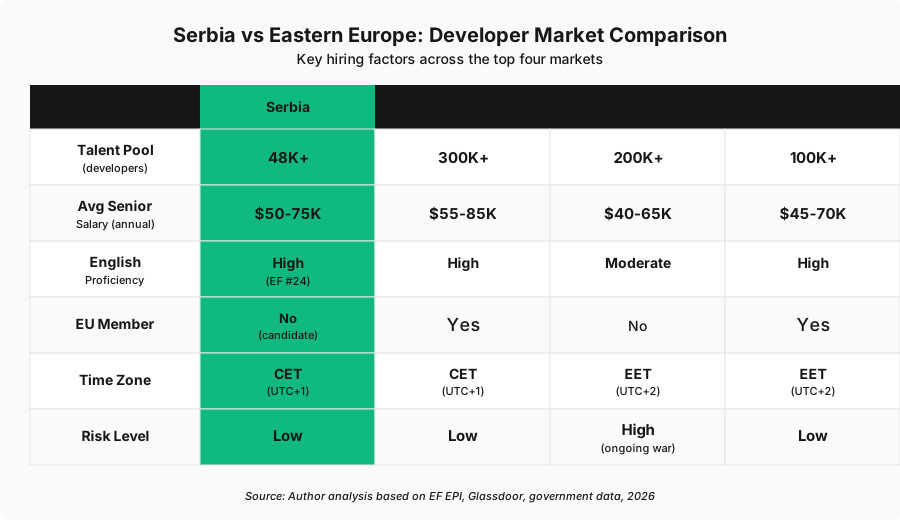
Serbia vs Poland. Poland has a larger talent pool (around 300,000+ IT professionals), more mature startup ecosystem, and EU membership which simplifies some legal aspects. But Polish developer salaries have climbed significantly. Senior developers in Warsaw command $60,000-$90,000, sometimes higher. Serbia offers 10-20% savings for comparable quality. Poland wins on pool size and EU alignment. Serbia wins on cost.
Serbia vs Ukraine. Before 2022, Ukraine was the dominant Eastern European hiring market. The talent quality remains excellent and Ukrainian developers are among the best in the world at competitive programming and algorithmic work. But the ongoing war creates real business continuity risk. Power outages, displacement, and uncertainty affect reliability in ways that no amount of talent can fully offset. Serbia has no comparable geopolitical risk. If risk-adjusted cost is your metric, Serbia comes out ahead right now. That could change if and when the conflict ends, but we're not there yet.
Serbia vs Romania. These two are the closest comparison. Similar salary ranges, similar talent quality, similar time zone (Romania is one hour ahead of Serbia). Romania has EU membership, which matters for some companies. Serbia has a slight English proficiency edge, ranking 24th on the EF English Proficiency Index with a "High" rating compared to Romania's "High" rating as well (EF EPI, 2024). Romania's IT sector is more mature in some specific verticals like cybersecurity. It's genuinely close. I'd pick based on specific stack needs and team fit rather than market-level differences.
Serbia's sweet spot is the company that wants Eastern European quality at a price point below Poland, with less geopolitical risk than Ukraine, and doesn't strictly require EU membership. If that describes you, Serbia should be your first call.
For comparison against a completely different market, take a look at hiring in South Africa where you get a different time zone profile and price point entirely.
What happens after you hire them
Hiring is the easy part. Making the relationship work long-term is where most companies drop the ball with remote international teams.
Onboarding matters more when you're remote. Your Serbian developer can't absorb culture by sitting next to someone in an office. Document your engineering norms. Record your architecture decisions. Create a 30-60-90 day plan. The investment in onboarding documentation pays dividends across every subsequent hire.
Communication norms need to be explicit. Decide upfront: what gets a Slack message, what gets a ticket, what needs a meeting. Serbian developers tend to be direct communicators which is refreshing compared to some cultures where indirect communication creates ambiguity. But they also tend to be less likely to flag problems early unless you explicitly create that expectation. Build a culture where raising blockers is rewarded, not punished.
Tooling for distributed teams is non-negotiable. You need visibility into work progress without micromanaging. Yander is what I use to keep distributed teams aligned. It handles async standups, workstream visibility, and goal tracking across time zones so nobody's blocked waiting for someone to wake up. Whatever tools you choose, make sure they support async-first workflows. Trying to force synchronous patterns on a team with a 6+ hour time zone gap will burn everyone out.
Serbian work culture has a few things you should know. Developers there tend to be loyal once they trust you. Job-hopping is less common than in the US market. But the flip side is that poaching is increasing as more international companies discover Serbia. Competitive compensation, growth opportunities, and genuine inclusion in product decisions are your retention tools. Don't treat your Serbian team as an outsourced cost center. Treat them as the product team they are.
Meet in person at least once a year. Serbia is easy to get to from anywhere in Europe (Belgrade has direct flights to most major European cities) and manageable from the US East Coast (one connection, 10-12 hours total travel). A week together every six months or annually does more for team cohesion than any amount of Zoom calls.
FAQ
What is the average salary for a software developer in Serbia?
The average salary depends heavily on experience and whether the employer is local or international. For developers hired by international companies remotely, junior roles pay $20,000-$30,000 per year, mid-level $35,000-$50,000, and senior $50,000-$75,000. Local market salaries are lower. The average net salary across all sectors in Serbia is roughly €860 per month (Statistical Office of the Republic of Serbia, 2024), so tech workers earning international rates are well above the national average.
Is it legal to hire contractors in Serbia from the US?
Yes. US companies can hire Serbian contractors directly. The contractor operates as a sole proprietor (preduzetnik) or through their own company, invoices you, and handles their own tax obligations in Serbia. The key risk is misclassification. Serbia's 2023 rules impose a 130-day threshold and exclusivity tests. If your contractor works primarily for you for extended periods, consider switching to an EOR arrangement to stay compliant.
What is the time zone overlap between Serbia and the US?
Serbia is on CET (UTC+1) in winter and CEST (UTC+2) in summer. US East Coast teams get 3-5 hours of overlap depending on daylight saving. US West Coast teams get 1-2 hours at best. For East Coast companies, this is workable with intentional process design. For West Coast companies, plan for a primarily async relationship.
Serbia vs Ukraine for hiring developers. Which is better?
Both markets have excellent developer talent. Ukraine has a larger pool and historically lower prices at the junior level. Serbia offers comparable quality at similar mid-to-senior price points with significantly less geopolitical and business continuity risk given the ongoing conflict in Ukraine. If stability and predictability are priorities, Serbia is the safer choice right now.
Do Serbian developers speak English?
Serbia ranks 24th globally on the EF English Proficiency Index with a "High" proficiency rating (EF EPI, 2024). English is taught from first grade in most Serbian schools, and university CS programs typically use English-language materials. In practice, mid-level and senior developers in Belgrade and Novi Sad speak and write English well enough for daily professional communication. Junior developers and those in smaller cities may need more support. Always assess English during your interview process rather than assuming.
Serbia isn't a secret anymore, but it's still underpriced for what you get. The 48,000+ developer pool, the strong university pipeline with 68% enrollment growth, the low tax burden, and the presence of companies like Microsoft and Epic Games all point in the same direction. This is a market that delivers.
The window won't stay open forever. As more companies discover Serbia, salaries will rise. Poland went through this cycle. Romania is going through it now. If you're going to build a team in Serbia, the economics favor moving sooner rather than later.
If you're managing a distributed team across Serbia and other markets, Yander makes the logistics disappear so you can focus on building product instead of fighting time zones and spreadsheets.
Written by
Yander Team
Employee Engagement Experts
The Yander team helps remote leaders understand and improve team engagement through data-driven insights. We believe in privacy-first approaches that support both managers and employees.