"AI hiring platform" is one of those terms that gets thrown around for everything from a resume parser with a chatbot to a fully autonomous recruiting system. They are not the same thing. And the difference matters a lot more than most buyers realize.
I keep talking to agency owners and startup founders who bought an "AI hiring tool" and then discovered it only does one thing. It screens resumes. Or it writes job descriptions. Or it schedules interviews. But it doesn't actually run the hiring pipeline. It just handles a slice of it and you're still doing the rest manually.
So here's what an AI hiring platform actually is, what it does at each stage, whether you need one, and what to look for if you decide to buy.
What an AI hiring platform actually is
The simplest way I can define it: an AI hiring platform is software where AI runs the core hiring workflow. Not assists it. Runs it.
That distinction matters because most tools on the market right now are traditional applicant tracking systems that bolted on some AI features after ChatGPT made it trendy. The AI generates a job description or scores a resume. But the ATS is still the product. The human recruiter is still the engine.
An AI-native platform is different. The AI is the engine. It sources, screens, assesses, schedules, and moves candidates through the pipeline with minimal human involvement. The recruiter's job shifts from doing the work to reviewing the work the AI already did.
There are roughly three tiers in the market right now.
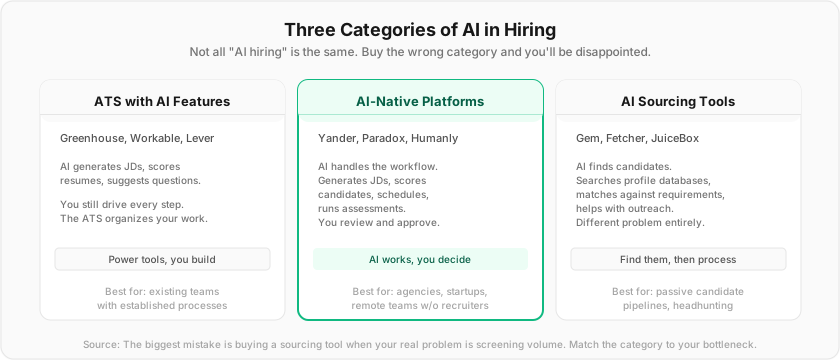
Traditional ATS with AI add-ons. Greenhouse, Workable, Lever. The core product is applicant tracking. AI features got layered on top. You still build workflows manually. You still move candidates between stages yourself. The AI helps at specific steps but it doesn't own the process.
AI-enhanced recruiting CRM. Gem, Ashby. These platforms were built more recently and AI is woven deeper into the product. Sourcing, outreach personalization, analytics. They're genuinely better than the first tier. But you're still the one driving.
AI-native pipeline automation. Paradox, Yander. AI handles the heavy lifting across the full pipeline. From job description generation through scoring, assessments, and scheduling coordination. You review and approve at key stages rather than doing every step manually. Human oversight is built in, not bolted on.
The category is growing fast. The global AI in HR market was valued at $3.25 billion in 2023 and is projected to reach $15.24 billion by 2030 (Grand View Research). That's a lot of money chasing a lot of different product visions. Which is exactly why you need to understand what you're actually buying.
What it does at each stage of the pipeline
Most articles about AI hiring platforms stay abstract. "It automates recruiting." Great. What does that actually mean in practice? Let me walk through each stage.
Job description generation. You give the platform a role brief. Title, key responsibilities, must-have skills, nice-to-haves. The AI generates a full job description optimized for the platforms it's going to be posted on. Inclusive language. Proper structure. SEO for job boards. What used to take 30 to 60 minutes per role now takes about 2 minutes of review time. That adds up fast when you're filling 10 roles.
Job distribution. The platform pushes the listing to multiple job boards simultaneously. LinkedIn, Indeed, Glassdoor, niche boards for your industry. No logging into each platform separately. No copying and pasting. No adjusting formatting for each board's requirements. One click and it's live everywhere.
Candidate sourcing. This is where AI gets genuinely interesting. The platform searches resume databases, LinkedIn profiles, and other talent pools to find people who match your requirements. Not just keyword matching. The AI understands that someone with "React and Node.js" experience is relevant to your "Full Stack Developer" posting even if those exact words aren't in the JD. Proactive sourcing instead of waiting for applications to come in.
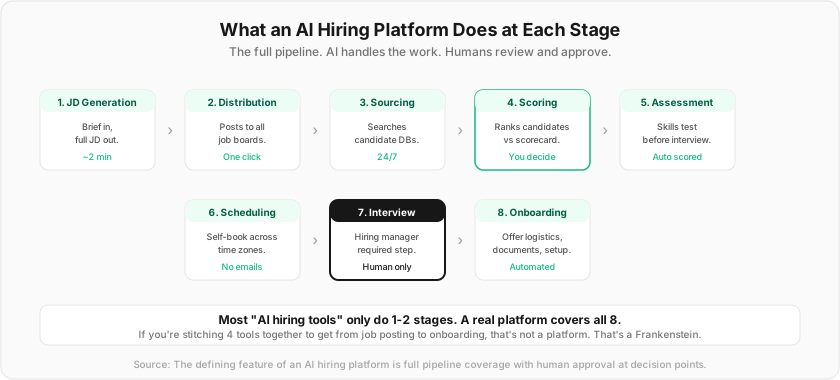
Screening and scoring. Candidates get scored against a weighted scorecard derived from your role requirements. The AI reads resumes, parses experience, matches skills, and assigns a score. You review the ranked shortlist and decide who moves forward. Instead of spending 26 hours reading 200 resumes, you're reviewing a scored list of the top candidates with clear reasoning behind each score.
Some platforms go further and generate follow-up questions based on gaps in the application. If a candidate lists project management experience but doesn't specify team size, the AI asks. This used to be the recruiter's job. Now it happens at 2 AM while you sleep.
Skills assessment. The platform generates role-specific assessments. A developer gets a coding challenge. A marketer gets a campaign strategy exercise. A sales hire gets a discovery call simulation. Candidates complete these before the interview, which means by the time you sit down with someone, you already know they can do the work. Not just that they can talk about doing it.
Interview scheduling. AI matches calendars across time zones. Candidates self-book from available slots. No more email ping-pong. No more "does Tuesday at 3 work? Oh wait, that's midnight for you." For remote teams hiring globally this alone saves hours per week. The average time to fill an open role sits at 36 to 44 days depending on the industry, and a significant chunk of that delay is scheduling logistics.
Onboarding kickoff. Offer letter generation. Document collection. System access requests. Onboarding task lists sent to the new hire and their manager. The handoff from "accepted the offer" to "productive on day one" happens automatically instead of falling through the cracks for two weeks.
Here's the thing that matters most. Most "AI hiring tools" only do one or two of these stages. A sourcing tool finds candidates but doesn't screen them. A screening tool scores resumes but doesn't schedule interviews. A scheduling tool books meetings but doesn't assess skills.
A real AI hiring platform covers the full pipeline. That's the defining feature of the category. If you're still stitching together four different tools to get from job posting to onboarding, you don't have an AI hiring platform. You have an expensive Frankenstein.
Who actually needs one
Not everyone does. I want to be honest about that because too many vendor sites act like every company on earth needs their product tomorrow. Here's who genuinely benefits.
Teams hiring 5+ roles per quarter without a dedicated recruiting team. This is the sweet spot. You're hiring enough that it's eating significant time but not enough to justify a full-time recruiter at $85,000 to $130,000 per year fully loaded (Glassdoor, 2026). An AI hiring platform gives you recruiter-level pipeline management without the headcount.
Agencies managing multiple client pipelines simultaneously. If you're running hiring for three or four clients at once, the cognitive overhead alone is brutal. Which candidate is for which role at which company? An AI platform keeps every pipeline organized and moving forward without you being the bottleneck.
Remote-first companies hiring across time zones. When your candidates are in Bogota, your hiring manager is in Berlin, and your CEO is in San Francisco, scheduling alone becomes a part-time job. AI handles the timezone math and the calendar coordination. That's not a luxury. It's a requirement for scaling a distributed team.
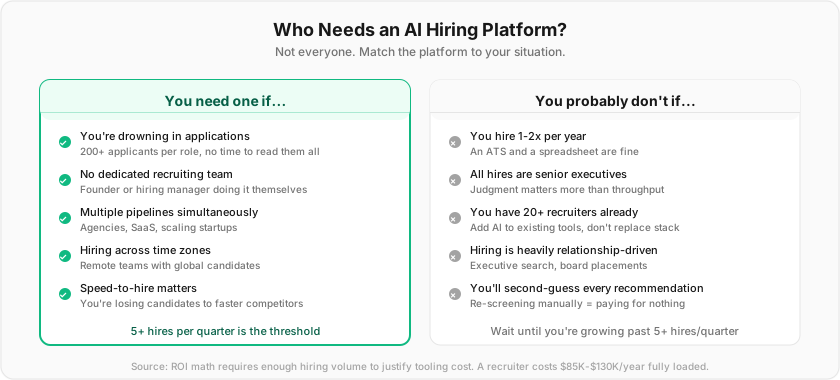
Startups scaling from 10 to 50 people. The founder is usually still doing all the hiring at this stage. They're also doing product, fundraising, sales, and everything else. Something has to give. An AI hiring platform lets them stay involved in the final decision without spending 20 hours a week on screening and scheduling. Yander was built specifically for this situation. Founders and small teams who need to hire well without hiring a recruiter first.
Anyone spending more time on logistics than actually interviewing. If your week looks like reading resumes, sending screening questions, chasing people for calendar availability, and formatting offer letters, then you're doing recruiter work. An AI platform does that recruiter work and gives you back the hours to do the thing that actually matters. Talking to candidates and making good decisions.
Who doesn't need one
Enterprise companies with 20+ recruiters and established processes. You already have the infrastructure. What you need is AI features inside your existing ATS or CRM. Ripping out your tech stack to adopt an AI-native platform would cause more disruption than it's worth. Look at adding AI tools to what you already use instead.
Companies hiring one or two people per year. This is overkill. Post on LinkedIn. Ask your network. Use a spreadsheet to track five candidates. You don't need pipeline automation for a pipeline that barely exists.
Companies where hiring is heavily relationship-driven. Executive search firms. Board placements. Senior leadership roles where the recruiter's network and judgment are the entire product. AI can assist with scheduling and logistics, but trying to automate the relationship part would hurt more than it helps. The human touch isn't just nice to have in these situations. It's the service.
Companies that aren't ready to trust the output. This one's less obvious but it's real. If your hiring manager is going to second-guess every AI recommendation and re-screen candidates manually anyway, you're paying for a tool you're not actually using. The ROI only appears when you actually let the platform do its job.
What to look for when evaluating
I've looked at dozens of these platforms and the differences show up in places most comparison articles ignore.
Pipeline coverage. How many stages does it actually automate? Some platforms market themselves as "full pipeline" but really only cover sourcing and screening. Ask specifically: does it generate JDs, distribute to job boards, screen, assess, schedule, and handle onboarding? Count the stages. If it only covers two or three, it's a feature, not a platform.
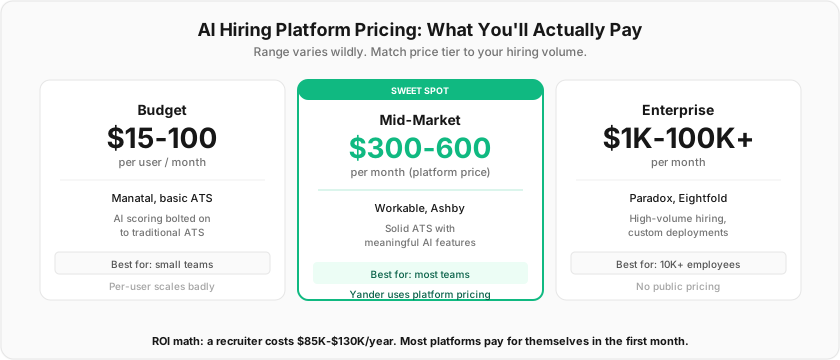
Pricing model. Per-user pricing gets expensive as you grow. A team of five paying $300 per seat per month is $18,000 a year. Platform pricing where you pay one fee regardless of team size makes the math better as you scale. Always model out what pricing looks like at 2x and 5x your current team size.
AI transparency. Can you see why the AI scored a candidate the way it did? If it's a black box that just says "85% match" with no explanation, you can't improve your process. And you can't defend your decisions if someone asks. Look for platforms that show the scoring logic.
Bias auditing. NYC Local Law 144 already requires annual independent bias audits for AI hiring tools used in the city. Illinois has the AI Video Interview Act. Colorado's AI Act is coming. The EEOC issued guidance on AI in employment decisions. If your vendor can't produce bias audit results, that's a problem today and a legal liability tomorrow.
Integration vs replacement. Does the platform replace your ATS or require one alongside it? Both approaches work but the costs are different. A platform that replaces your ATS saves you one subscription. A platform that sits on top of your ATS means you're paying for both.
Time to value. How long from signup to your first automated hire? Some platforms need weeks of configuration and training data. Others work out of the box. If you're a small team that needs to hire next month, a 90-day implementation timeline doesn't help you.
The current market
The AI hiring platform space is crowded and sorting through it is genuinely confusing. Here's how I think about the market in broad categories.
High-volume hiring. Paradox leads here with their conversational AI assistant Olivia. Built for retail, healthcare, logistics, and hospitality where you're hiring hundreds of people per quarter. Chipotle cut their time-to-hire from 12 days to 4 using it. If you're filling 50 identical roles per month, this is the category to look at.
All-in-one ATS plus AI. Gem and Ashby both combine applicant tracking, CRM, and AI in one platform. Gem is expensive but powerful. Ashby has best-in-class analytics. Both are designed for mid-market teams with dedicated recruiters who want better tools.
Sourcing-focused AI. Fetcher and HireEZ specialize in finding candidates. If your main problem is that not enough qualified people are applying, these tools go out and find them. They're complements to your ATS, not replacements.
Full pipeline with human oversight. Yander sits here. AI handles job description generation, candidate scoring, assessments, and scheduling coordination across the full pipeline. You review and approve at each stage. Built for remote teams, agencies, and startups that want one system instead of five separate tools. I wrote our honest comparison of AI recruiting tools that goes deeper on each of these if you want the detailed breakdown.
The honest state of AI hiring in 2026
AI hiring tools have gone from novelty to expectation. HR leaders are increasingly treating AI adoption as a competitive necessity, with SHRM's 2024 research showing rapid acceleration in AI adoption across HR functions. The shift happened fast. The shift happened fast.
But the lawsuits are real and getting more frequent. NYC Local Law 144 has been in effect since July 2023 and requires independent bias audits for automated employment decision tools. Illinois regulates AI-conducted video interviews. Colorado's AI Act creates obligations for "high-risk" AI systems, and hiring tools are explicitly included. The EU AI Act classifies employment-related AI as high-risk and imposes requirements around transparency, human oversight, and documentation.
None of this means you shouldn't use AI for hiring. It means you need to pick vendors who take compliance seriously. Ask for their bias audit results. Ask how they handle adverse impact analysis. Ask what happens when a candidate challenges an AI-driven rejection. If the vendor can't answer those questions clearly, that tells you everything.
The tools that will win long term are the ones that are transparent about how their AI works and can produce audit documentation when regulators or candidates ask for it. That's not a nice-to-have anymore. It's table stakes.
I genuinely believe AI hiring platforms are one of the highest-ROI tools a growing company can adopt right now. The time savings are real. The cost savings are real. The speed advantage in a competitive talent market is real. But you have to pick the right tool for your situation, understand what it actually does versus what the marketing says it does, and stay on the right side of the regulations.
That means doing the work to evaluate properly. Not just reading listicles.
Frequently asked questions
What's the difference between an AI hiring platform and an ATS?
An ATS is a database that tracks candidates through your hiring process. You do the work and the ATS organizes it. An AI hiring platform does the work. It screens, scores, assesses, schedules, and moves candidates through the pipeline with minimal human involvement. Some AI platforms include ATS functionality. Others sit on top of an existing ATS. The key difference is who's doing the heavy lifting.
How much does an AI hiring platform cost?
It depends heavily on the category. Basic AI add-ons for your existing ATS might be included in your subscription or cost $50 to $100 per month extra. Mid-tier platforms like Ashby start around $360 per month. Enterprise solutions like Paradox don't publish pricing but typically start at $1,000 per month and scale based on hiring volume. Full-pipeline platforms vary. Per-user pricing ranges from $15 to $400 per seat per month depending on capabilities.
Will AI replace recruiters?
Not the good ones. AI replaces the parts of recruiting that recruiters hate doing. Reading hundreds of resumes. Scheduling interviews across time zones. Sending rejection emails. Writing job descriptions. The parts that require human judgment, like evaluating culture fit, selling candidates on the role, and making final hiring decisions, still need people. What changes is that one recruiter with an AI platform can handle the volume that previously required three.
Is AI hiring legal?
Yes, with conditions. There's no blanket ban on using AI in hiring. But there are growing regulations about how you use it. NYC requires annual bias audits for automated hiring tools. Illinois regulates AI video interviews. The EEOC has issued guidance that existing anti-discrimination laws apply to AI-driven decisions. Colorado and the EU have broader AI regulations that include hiring. The short version: you can use it, but you need to be able to explain and defend how it makes decisions.
What is the best AI hiring platform?
It depends on your situation. For high-volume hiring at scale, Paradox. For teams that want a modern ATS with strong AI features, Gem or Ashby. For remote teams, agencies, and startups that want to automate the full pipeline without building a recruiting department, Yander. I wrote a detailed comparison of the top AI recruiting tools that breaks down each option with honest pros and cons.
Written by
Yander Team
Employee Engagement Experts
The Yander team helps remote leaders understand and improve team engagement through data-driven insights. We believe in privacy-first approaches that support both managers and employees.