I run a marketing agency and I've watched what happens when agency owners try to scale hiring for their clients without changing their tooling. They hire more recruiters. Then more. Then they realize the margin math doesn't work anymore because every new client requires another body on the team.
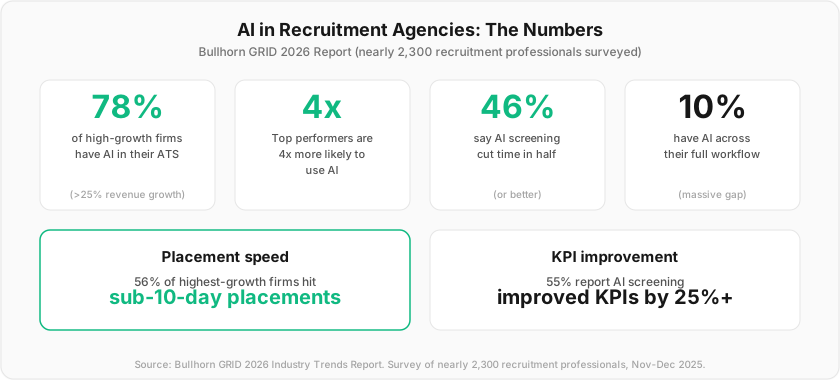
The agencies that are growing fastest right now aren't hiring more recruiters. They're getting more out of the ones they have. Bullhorn's 2026 GRID report surveyed nearly 2,300 recruitment professionals and the numbers are clear: top-performing firms are 4x more likely to have AI embedded in their workflow. 78% of firms with over 25% revenue growth have AI baked into their core workflow. And 56% of the highest-growth firms are hitting placement times under 10 days.
But here's the thing. Only 10% of agencies have AI embedded across their full workflow. Most are running one or two AI tools that don't connect to anything else. They've got an AI sourcing tool here, a chatbot there, and a stack of disconnected point solutions that create more work than they save.
I want to walk through what the full AI stack actually looks like for a recruitment agency in 2026. Not just a list of tools. The actual workflow, what each piece does, and where the biggest ROI is.
The core: your ATS is the foundation
Everything plugs into your ATS. If your ATS doesn't have AI capabilities or doesn't integrate well with AI tools, nothing else matters. You'll spend half your time copying data between systems.
The agency ATS market has a few clear leaders right now.
Bullhorn is the market leader for mid to large staffing agencies. They acquired Textkernel for AI candidate matching and built an "Amplify" AI layer on top. Over 300 marketplace integrations. If you're doing 50+ placements a month, this is probably where you end up. Pricing is enterprise and not public.
Vincere is strong for mid-market agencies that want everything in one system. ATS, CRM, timesheets, invoicing, analytics. Their AI Copilot generates candidate summaries and scores CVs. 50+ pre-built analytics dashboards, which matters when clients ask for performance data. Works well for agencies doing perm, contract, and temp.
Manatal is the budget option at $15/user/month. AI recommendation engine that scores candidates against job criteria. Pulls candidate data from 20+ platforms for enrichment. Good for smaller agencies. The limitation: reporting is basic and API access is locked behind the $55/user/month tier.
Recruiterflow is the newer AI-first option built specifically for agencies. AI agents, sequencing, data enrichment, and automation built in from the start rather than bolted on. Growing fast but smaller customer base than Bullhorn or Vincere.
Loxo combines sourcing, ATS, and CRM in one platform. $100 to $250/user/month. Especially good for boutique and specialist agencies that want a clean, modern interface without enterprise complexity.
And then there's Yander, which takes a different approach entirely. Instead of being a tool the recruiter uses, it handles the heavy lifting across the pipeline. Generates the JD, posts to job boards, scores candidates against a scorecard, runs skills assessments, and coordinates scheduling. The recruiter reviews and approves at every stage rather than doing each step manually. Built for agencies that want to handle more client pipelines without adding headcount.
Sourcing: finding candidates before they find you
This is where a lot of agency AI investment goes because sourcing is the most time-intensive part of the job.
HireEZ (formerly Hiretual) aggregates profiles from 45+ platforms including LinkedIn, GitHub, Stack Overflow, and personal websites. It has an AI Boolean search builder that generates complex search strings for you. Automated outreach sequences let you contact candidates at scale. Runs about $500 to $600/user/month.
Fetcher takes a hybrid approach where AI surfaces candidates and a human team vets them. The AI learns from your successful placements to refine its search parameters over time. Pricing starts at $379/month on annual billing.
Findem analyzes over 100,000 candidate attributes beyond keywords. Better than most tools for hard-to-fill specialist roles where keyword matching falls short.
SeekOut is strong for diversity-focused sourcing. Advanced filtering by demographics, skills, and background. Similar price range to HireEZ.
The honest reality: most agencies don't need a dedicated sourcing tool if their ATS already has good search. Bullhorn with Textkernel, Loxo's built-in sourcing, and Recruiterflow's enrichment features handle sourcing for most agency use cases. Standalone sourcing tools make sense when you're doing high-volume specialist placements where the standard candidate pool doesn't cut it.
Screening and engagement: the biggest time saver
This is where the ROI math gets compelling. Bullhorn's data says 46% of firms using AI screening report it cut their screening time in half. 55% say it improved their KPIs by more than 25%.
Paradox (Olivia) is the leader for high-volume screening. It's a conversational AI that handles candidate questions, screening, and scheduling via chat, SMS, and voice. Clients report high interview scheduling completion rates with minimal human intervention. If you're doing temp or contract staffing where you're processing hundreds of candidates per week, this pays for itself fast.
Humanly does mid-market screening with bias detection built in. Good for agencies that need to demonstrate fair hiring practices to clients.
For agencies that want screening built into the pipeline rather than as a separate tool, Yander scores every applicant against a weighted scorecard derived from the job description. The recruiter reviews the scored shortlist and decides who moves forward. Instead of reading 200 resumes, you're reviewing a ranked list of 15 with clear reasoning for each score.
Scheduling: the hidden time drain
Scheduling doesn't feel like it should be a big deal until you're coordinating interviews across three time zones for eight different clients simultaneously.
Calendly (Teams plan) is the most widely used, especially by smaller agencies. Round-robin scheduling, multi-interviewer support. Free tier exists.
GoodTime handles panel interview orchestration and balances interviewer load across your team. Integrates with most major ATS platforms.
Arrange is built specifically for external recruiting agencies placing candidates with client companies. Niche but solves the specific problem of scheduling candidates into a client's calendar without the client having to do anything.
How agencies are actually using ChatGPT
This one surprised me. Beyond the dedicated tools, most agency recruiters are using ChatGPT, Claude, or Gemini daily for work that used to take hours.
Job description writing is the fastest adoption area. Feed in brief client notes and get a keyword-optimized JD back in seconds. Agencies report fewer revision cycles with clients because the first draft is already solid.
Outreach emails are the second biggest use. Personalizing cold outreach for hundreds of candidates per month used to mean either sending generic templates or spending 5 minutes per message. Now you feed in the candidate's background and the role details and get a tailored message in seconds.
Candidate summaries for client shortlists save 20 to 30 minutes per candidate. Instead of manually writing up why each person made the shortlist, you paste the resume and interview notes and get a structured summary.
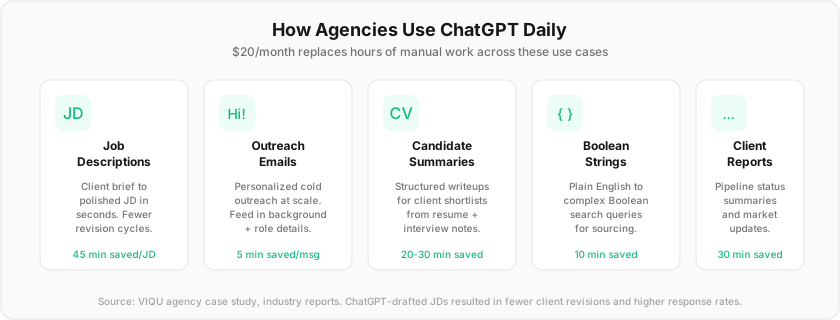
Boolean search string generation is an underrated use case. Describe what you're looking for in plain English and let the LLM build the complex Boolean string for your sourcing tool.
VIQU, a UK recruitment agency, reported that ChatGPT-drafted job ads resulted in fewer client revisions and higher candidate response rates than their manually written versions.
The real numbers on ROI
I want to be specific because "AI saves time and money" is meaningless without math.
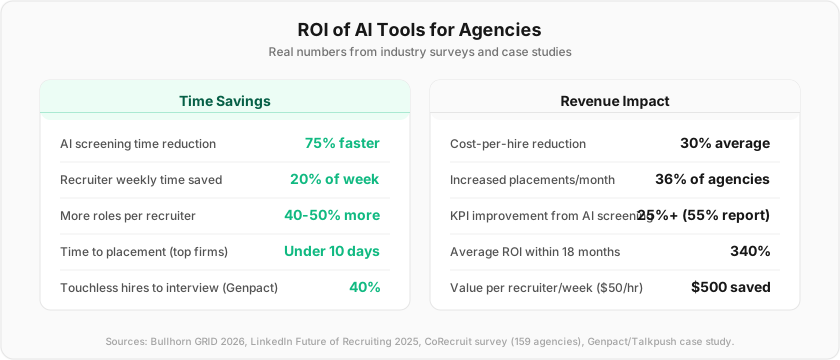
Agencies using AI screening report 75% faster candidate screening on average. That's not a small improvement. If your team spends 20 hours a week on screening, that drops to 5 hours.
36% of agencies in a CoRecruit survey of 159 staffing firms reported increased placements per month after adopting AI tools. Not faster processes. More actual placements. Revenue.
Agencies report being able to manage 40 to 50% more open roles per recruiter without adding headcount. That's the margin improvement that matters. More clients, same team size.
Cost-per-hire drops 30% on average, with some North American firms hitting 40% reduction.
LinkedIn's 2025 Future of Recruiting data says recruiters using AI save about 20% of their work week. For a recruiter billing $50/hour, that's $500/week in recovered time. Per recruiter.
Genpact published a case study where their AI engine enabled 40% touchless hires through to interview stage, with a 15% recruiter productivity increase and time-to-hire dropping from 62 to 43 days.
What can go wrong
I'm not going to pretend this is all upside.
Bias in AI screening is documented and real. A study led by researchers at Stanford, UC Berkeley, and Oxford, published in Nature in October 2025, found that AI resume-screening tools rated older male candidates higher than female and younger candidates, even when the resume data was identical. Amazon famously scrapped an internal AI hiring tool that penalized resumes containing the word "women's." If your AI tool screens out candidates unfairly and a client gets hit with a discrimination claim, the liability chain includes you.
Compliance is getting stricter. NYC requires annual bias audits for automated hiring tools. California requires human override capability and 4-year record retention. The EU's GDPR creates additional obligations for candidate data processed by AI. Data privacy and AI compliance are increasingly cited as top concerns among staffing executives on both sides of the Atlantic.
AI struggles with nuance. Creative roles, career gaps, non-linear backgrounds, candidates who changed industries. AI matching works best when the criteria are clear and measurable. For specialist or executive search, over-relying on AI screening can cost you great candidates who don't fit neat patterns.
Candidate experience can suffer. If every touchpoint is automated and impersonal, candidates notice. This matters most for agencies doing specialist or executive search where the relationship is the product. High-volume temp staffing can tolerate more automation. White-glove executive search cannot.
Tool fragmentation is the default. 90% of agencies don't have AI connected end-to-end. They're running a sourcing tool that doesn't talk to their ATS that doesn't connect to their scheduling tool. Data lives in silos. Recruiters copy and paste between systems. The "AI stack" ends up creating more admin work, not less.
The fix for that last one is either choosing an all-in-one platform (Bullhorn, Vincere, Yander) or making sure your tools integrate before you buy them. Check the integration directory. If two tools don't connect natively or through Zapier, assume they never will.
Building your stack: where to start
If you're an agency that hasn't adopted AI tools yet, don't try to do everything at once. Here's the sequence I'd recommend.
First: get your ATS right. If your current ATS doesn't have AI capabilities and doesn't integrate with AI tools, switch it. This is the foundation. Everything else plugs into it.
Second: add AI screening. This is the highest-ROI single addition. Whether it's built into your ATS or a standalone tool like Paradox, automated screening saves the most recruiter hours per dollar spent.
Third: automate scheduling. Calendly Teams is free to start and eliminates the interview coordination overhead immediately.
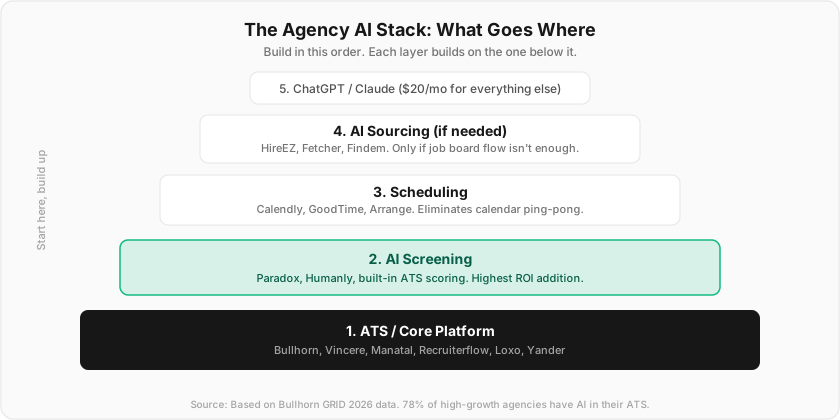
Fourth: add AI sourcing if you need it. Only if your candidate flow from job boards and your existing database isn't sufficient. Most agencies don't need standalone sourcing until they're doing 20+ placements per month.
Fifth: use ChatGPT for everything else. JD writing, outreach personalization, candidate summaries, client reports. This costs $20/month and replaces hours of manual writing.
Or skip the assembly process entirely and use a platform that handles the full pipeline from the start. That's what Yander does. One system for the entire hiring workflow, built for agencies managing multiple client pipelines.
FAQ
What's the best AI tool for a small recruitment agency?
Manatal at $15/user/month is the cheapest credible option with AI features. If you want more automation and don't mind a higher price point, Recruiterflow or Loxo give you AI-first capabilities without enterprise pricing. For full pipeline automation, Yander eliminates the need to stitch tools together.
Will AI replace recruitment agencies?
No. AI replaces the manual parts of the job. Screening, scheduling, outreach, data entry. The parts that make agencies valuable, understanding client needs, selling candidates on opportunities, managing relationships, negotiating terms, those still require humans. AI lets you do more of the valuable work by automating the busywork.
How much should an agency budget for AI tools?
Depends on your size. A 5-person agency can get started with Manatal ($75/month) plus ChatGPT ($20/month) for under $100/month. A 20-person agency running Vincere or Bullhorn with sourcing and scheduling tools is looking at $2,000 to $5,000/month. The ROI math works when you calculate what one additional placement per month is worth to your revenue.
Do candidates know when AI is screening them?
They should. NYC Local Law 144 requires 10 business days notice before AI is used in hiring decisions. Illinois requires notification and consent for AI video interviews. Even where it's not legally required, transparency builds trust. Tell candidates AI is part of the process. Most are fine with it. 67% are comfortable with AI screening as long as a human makes the final decision (Glassdoor, 2024).
Written by
Yander Team
Employee Engagement Experts
The Yander team helps remote leaders understand and improve team engagement through data-driven insights. We believe in privacy-first approaches that support both managers and employees.